
The theater was packed. Hundreds of people enjoying a show when suddenly someone shouted “Fire!” There was no fire. No smoke. Not even a burning match. But within seconds, panic erupted. People trampled each other rushing for exits. Lives were lost not from flames, but from fear of flames that never existed.
This scenario has repeated throughout history, and it reveals something chilling about human psychology: fear doesn’t need to be real to control us. It just needs to feel real.
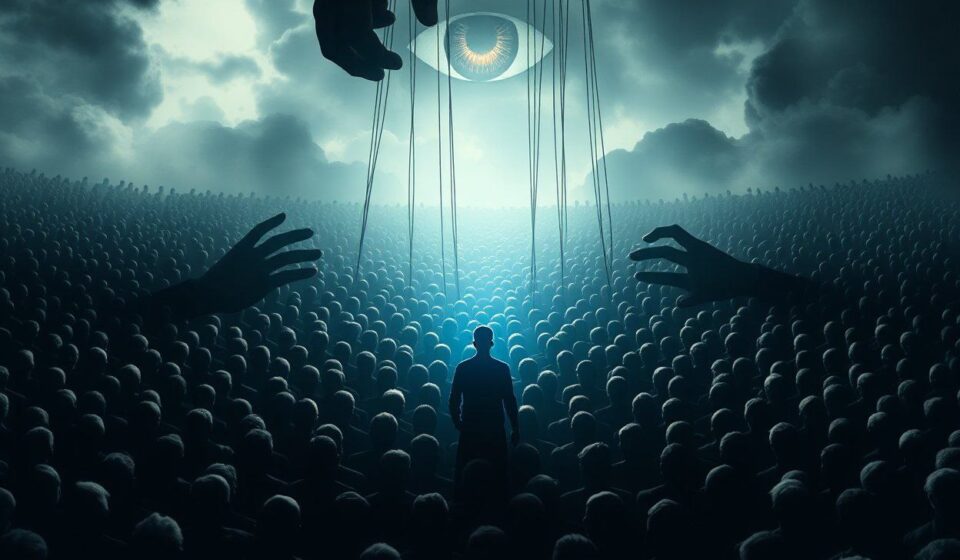
For anyone who understands this principle, fear becomes the ultimate instrument of power. Governments have wielded it to pass sweeping legislation. Corporations have used it to sell products. Media has exploited it for ratings. And throughout history, those who mastered the psychology of fear have shaped the world in ways most people never consciously recognize.
Understanding how fear-based control works isn’t about becoming paranoid. It’s about developing immunity to manipulation. It’s about recognizing when your emotional buttons are being pushed so you can choose not to react. Because once you see these mechanisms clearly, you can’t unsee them and that awareness becomes your greatest protection.
Why Fear Is the Most Powerful Psychological Weapon
Fear isn’t just another emotion sitting alongside happiness or curiosity. It’s the emotion that hijacks everything else. When you’re genuinely afraid, your brain doesn’t care about logic, long-term thinking, or moral principles. It cares about one thing: immediate survival, at any cost.
This makes evolutionary sense. Our ancestors who heard rustling grass and assumed “predator” survived more often than those who assumed “wind.” The cautious ones, the fearful ones, lived long enough to reproduce. We’re all descendants of the paranoid, which means our brains come hardwired with what psychologists call a “negativity bias” we’re naturally more attuned to potential threats than potential rewards.
This biological reality makes fear the most efficient control mechanism ever discovered. When people are afraid, they become remarkably compliant. They’ll surrender freedoms they’d normally defend fiercely. They’ll support policies that contradict their stated values. They’ll attack others who pose no actual threat. And they’ll do all of this while believing they’re acting rationally.
I watched this during the pandemic’s early days. Intelligent, educated people were panic-buying toilet paper not because there was any logical supply chain reason for shortages, but because fear bypasses logic entirely. The fear of scarcity created actual scarcity. Shelves emptied because people feared they would empty.
But here’s what makes fear particularly insidious as a control tool: it’s contagious. Psychologists call this “emotional contagion.” Emotions spread through groups like viruses, but fear spreads faster and more intensely than joy, sadness, or anger. One person’s panic can trigger mass hysteria.
When you’re in a fear state, your prefrontal cortex the rational, decision-making part of your brain, essentially shuts down. Your amygdala, the primitive fear center, takes control. You stop thinking critically and start reacting instinctively. You become suggestible, desperate for someone to tell you what to do to make the terrible feeling stop.
This is precisely why fear remains the weapon of choice for anyone seeking control over groups. It doesn’t require sophisticated arguments or careful persuasion. You just trigger that primal alarm system, and suddenly people will follow directives they’d normally question.
The Neuroscience Behind Mass Manipulation
Understanding what actually happens in your brain during fear responses helps you resist manipulation. It’s not mystical, it’s mechanical.
When your brain perceives threat, the amygdala activates before conscious awareness even registers what’s happening. This almond-shaped cluster of neurons functions like an emergency alarm, triggering a cascade of physiological responses. Your hypothalamus activates your sympathetic nervous system, flooding your body with stress hormones. Heart rate spikes. Pupils dilate. Blood flows from your digestive system toward your muscles, preparing for fight or flight.
Critically, this entire sequence happens in milliseconds long before your rational brain can evaluate whether the threat is genuine. Your amygdala evolved to err on the side of caution because in humanity’s evolutionary past, the cost of a false alarm was minor compared to missing a real threat.
This is why frightened populations are so easy to manipulate. Controllers don’t need to convince your rational mind of anything. They just need to trigger your amygdala, and your own biology handles the rest.
The group dynamics amplify this effect through mirror neurons brain cells that fire both when we perform actions and when we observe others performing them. This neurological basis of empathy also makes emotions contagious. When you see someone experiencing fear, your mirror neurons activate similar patterns in your brain. In crowds, this compounds exponentially, creating feedback loops that spiral into mass panic.
Skilled manipulators understand this perfectly. They don’t need to make everyone afraid individually. They just trigger fear in a few visible people, and the mirror neurons spread it through the population like wildfire.
There’s another mechanism at play: stress hormones enhance memory formation. When you’re afraid, your brain releases chemicals that make frightening experiences encode more deeply than neutral information. You remember threats far more vividly than reassurances.
This explains why negative political advertising outperforms positive messaging. Why news follows the “if it bleeds, it leads” principle. Fearful messages etch themselves into memory in ways calm, rational information simply cannot.
Creating an Enemy: The “Us vs Them” Trigger
Perhaps the most reliable fear-control method is giving people someone specific to fear. Not an abstract threat, but a concrete group who can be blamed, feared, and dehumanized.
This exploits our in-group bias humans naturally favor their own group and distrust outsiders. This kept our ancestors safe from hostile tribes, but in modern society it’s a vulnerability that can be ruthlessly weaponized.
The enemy-creation process follows predictable steps. First, identify a group different enough to be “other” but present enough to seem threatening. Immigrants, religious minorities, political opponents any distinguishable group works.
Second, attribute negative characteristics to this group collectively, not as individuals. “They” are dangerous. “They” are destroying your way of life. Nuance disappears, replaced by sweeping generalizations.
Third, connect this group to existing anxieties. Economic insecurity? Blame them for stealing jobs. Safety concerns? Blame them for crime. Cultural change? Blame them for destroying traditions. The enemy becomes a universal scapegoat.
Fourth, and most dangerously, employ dehumanizing language. The group stops being described as people and becomes vermin, invaders, or cancer. History demonstrates that once dehumanization is complete, atrocities become possible that would have been unthinkable otherwise.
I’ve watched this pattern during election cycles where political opponents weren’t portrayed as people with different policy views but as existential threats requiring defeat at any cost. The fear of “them” winning becomes so overwhelming that normal democratic principles start feeling expendable.
The brilliance of enemy-creation is that it provides an outlet for anxiety. Frightened people need someone to blame, and if you provide a target, they’ll often accept it without critical examination. Having a clear villain simplifies a complex world into good versus evil.
The antidote is straightforward but difficult: humanization. When told to fear a group, seek individual stories. Talk to actual members. You’ll almost always discover ordinary people with hopes and complexities that shatter the simplistic narrative. But this requires effort that frightened people rarely have energy for.
Media Amplification: The 24-Hour Fear Cycle
Modern media has become perhaps the most effective fear amplification system ever created, not through conspiracy but through the mechanics of attention economics.
The uncomfortable truth: fear sells. Research consistently shows negative news generates significantly more engagement than positive stories. News organizations competing for attention in fragmented media landscapes have learned this lesson thoroughly.
The 24-hour news cycle creates constant hunger for content, and fear-inducing material fills that hunger efficiently. Plane crashes, violent crimes, disease outbreaks these stories get repeated and analyzed for days, often far beyond their statistical significance.
This shapes perception dramatically. Violent crime has declined for decades in most developed nations, yet most people believe it’s increasing. Why? Constant exposure to crime stories. Each story is factually accurate, but the cumulative effect distorts reality.
Psychologists call this “availability bias” we judge likelihood based on how easily we recall examples. When plane crashes dominate news, we overestimate flying dangers despite being far more likely to die driving to the airport.
Social media algorithms exponentially amplify this. Designed to maximize engagement, they prioritize fear-generating content. The most frightening messages get amplified and shared, creating information cascades that make threats seem far more prevalent than reality.
I’ve noticed this in my own feeds. After controversial events, within hours I’m flooded with extreme reactions and frightening interpretations. Measured, contextual analysis gets buried under avalanches of fear and outrage.
Communications researcher George Gerbner identified “mean world syndrome” people consuming large amounts of fear-focused media believe the world is far more dangerous than reality. They overestimate crime rates, health risks, and violence likelihood. They become chronically anxious, perceiving threats everywhere.
The solution isn’t abandoning news entirely but consuming it critically. Ask yourself: is this information helping me make better decisions, or just making me afraid? Is this a statistically significant threat or a rare event amplified for engagement?
The Illusion of Safety: Trading Freedom for Protection
When sufficiently afraid, people accept almost any promise of safety, even requiring surrender of freedoms once considered sacred. This trade, liberty for security is among the oldest and most effective control mechanisms in civilization.
The pattern is straightforward: create or amplify a threat, offer protection, then implement control measures while claiming they’re necessary for safety. The frightened population accepts restrictions they would have rejected in calmer times.
Airport security after 9/11 provides a perfect example. Within months, we went from walking freely to gates to removing shoes, surrendering liquids, and accepting body scanners. These measures persist decades later, long after acute fear faded. Studies show much of this “security theater” is ineffective at preventing attacks, but it serves a psychological function, making people feel safer, even if they’re not actually safer.
That key word: “feel.” Fear-based control rarely concerns actual safety it’s about perception of safety. People don’t need genuine protection; they need to feel protected. That feeling can be generated through visible security displays, even if they don’t meaningfully reduce risk.
This explains why authoritarian governments throughout history emphasize security as justification for expanding power. The specific threat foreign invasion, internal subversion, terrorism, disease matters less than the fear it generates and the control it justifies.
The problem: once you surrender freedom for safety, you rarely reclaim it. Emergency measures become permanent. Temporary authority expansions become standard procedure. Because admitting overreaction or unnecessary measures means confronting the uncomfortable truth of manipulation by our own fear.
There’s also what I call the “ratchet effect.” Each crisis ratchets the baseline of acceptable control higher. What seemed like dystopian overreach a generation ago becomes normal. The next crisis ratchets up from that new baseline.
Sophisticated controllers don’t need to seize total power immediately. They just need to create a series of crises, each justifying small authority expansions. Over time, incremental changes accumulate into fundamental transformations.
The antidote is asking difficult questions when afraid: What exactly is the threat? How likely is it to affect me personally? What are we surrendering? Is this measure actually effective or just performative? And crucially: who benefits from my fear and from proposed measures?
Building Immunity: Critical Thinking as Self-Defense
Understanding fear-based manipulation is only the beginning. The real challenge is building practical immunity to navigate increasingly fear-saturated information environments without being controlled.
The foundation is what I call “emotional awareness without reactivity.” Acknowledge your fear when it arises denial doesn’t work but don’t immediately act on it. Create space between feeling and response.
When fear rises, use it as a trigger for investigation rather than action. Ask: What exactly am I afraid of? Is this fear based on immediate personal danger or a narrative I’m being told? What evidence supports this fear, and what contradicts it?
Seek primary sources. Don’t rely on interpretations or second-hand accounts. Look at actual data, actual studies, actual statements when possible. You’ll often discover reality is far more nuanced than fear-inducing headlines suggested.
Cultivate diverse information sources. Consuming only media confirming existing fears leaves you vulnerable to manipulation. Intentionally seek perspectives challenging your assumptions. This doesn’t mean believing everything, but exposing yourself to different interpretations enables critical thinking.
Practice statistical thinking. Most people assess probability poorly, making them vulnerable to frightening anecdotes. Learn to ask: How common is this really? What are my actual odds? How does this risk compare to others I face daily without fear?
Develop a personal decision-making framework independent of emotional state. What are your core values? What principles guide choices? When these are clear in advance, fear can’t easily push you into contradictory actions.
Build community with people valuing critical thinking over conformity. Having friends or colleagues with whom you can discuss fears openly, question narratives together, and reality-check perceptions is invaluable. Fear loses power when examined collaboratively rather than experienced in isolation.
Distinguish between preparation and panic. Reasonable preparation for plausible risks is wise. Panic-driven hoarding, extreme lifestyle changes, or cutting off relationships based on fear signals manipulation. Ask: Is this action making me genuinely safer, or just making me feel like I’m doing something?
Finally, remember courage isn’t absence of fear it’s action despite fear. You’ll still feel afraid sometimes. The goal isn’t never experiencing fear but ensuring fear serves rather than controls you, that it informs decisions rather than dictates them.
The psychology of fear represents perhaps the most powerful force in human societies, capable of overriding reason, compassion, and principle. Throughout history, those understanding this psychology have shaped civilizations and controlled populations with remarkable efficiency.
But understanding cuts both ways. The knowledge enabling manipulation also enables resistance. Once you see the mechanisms the neuroscience, media amplification, us-versus-them framing, freedom-for-safety trades you can’t unsee them.
This awareness is uncomfortable. It means recognizing you’re constantly subjected to fear-based manipulation from multiple sources. It means questioning messages your social group accepts without examination. It means being the person who asks “why should I be afraid?” when everyone already is.
But this discomfort is the price of freedom. Real freedom isn’t just political or economic it’s psychological. It’s choosing your responses rather than having them programmed by those who would control you through fear.
The next time you feel that fear surge from news, social media, or political messaging, pause. Breathe. Ask questions. Seek context. Remember your fear, while real, might not be based on reality. And recognize that someone, somewhere, benefits from keeping you afraid.
Your fear isn’t your enemy, but those deliberately weaponizing it against you certainly are.